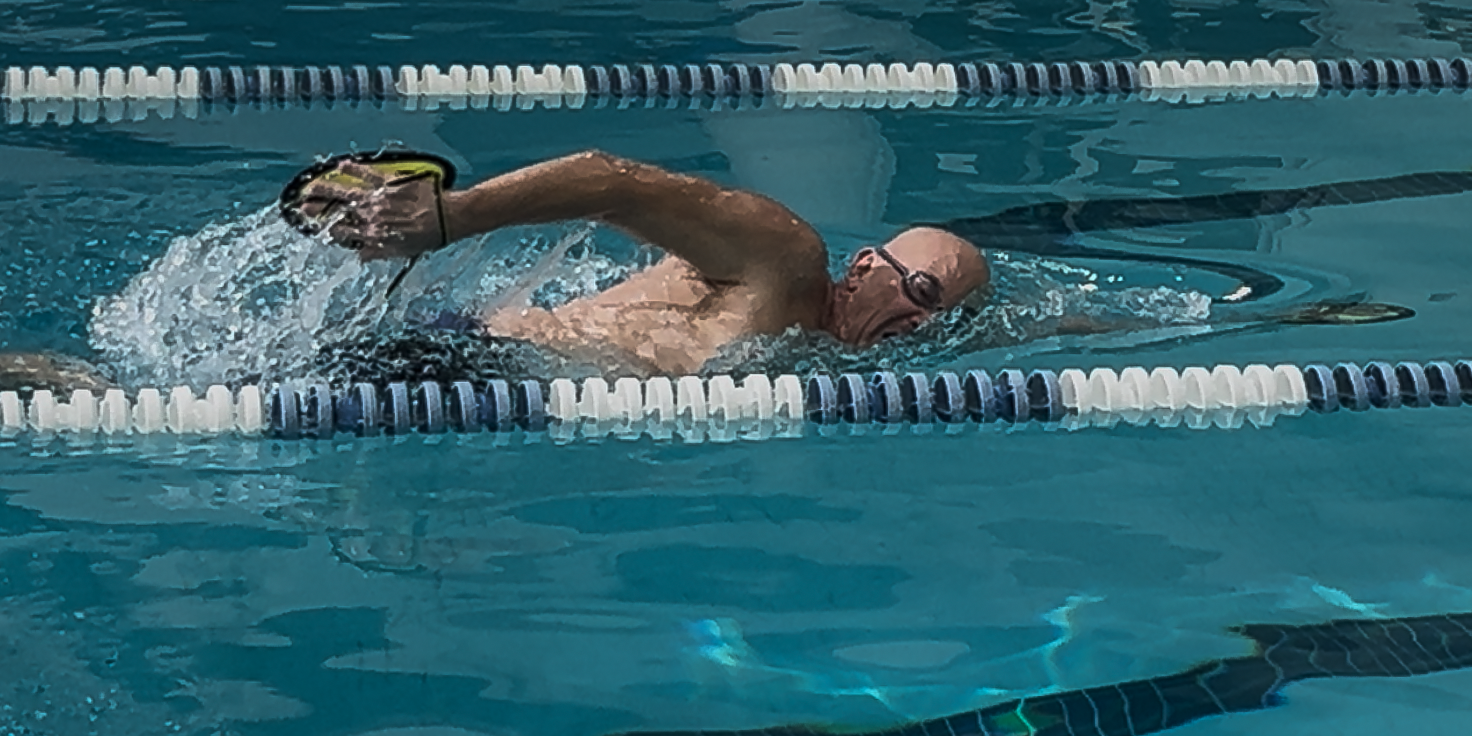
Training Techniques for Triathlon Swimmers
Triathlon Swimmers have gotten fairly obvious to me over the years. Generally, but not always, they are pretty fit but mediocre swimmers. And working really hard at it.
I’m not a triathlete but am a pretty decent swimmer.
There are a few things that I observe with triathlon swimmers that are fairly common with all swimmers.
You are generally not going to win a triathlon in the swim part of the race. But you don’t want to come last either.
And, very importantly, you likely don’t want to come out of the water completely exhausted.
Being completely beat up before you even get to the cycling and running part isn’t good.
I tell other swimmers that I’m lazy. I’m efficient. And being efficient one can still move along at a pretty good pace.
Two things to work on. One, general fitness. And two, technique.
Fitness
Most swimmers that I see, including triathletes, get in the water, swim a steady pace for a certain time or number of lengths and call it a day.
Not the way to do it. There have so many studies that show varying one’s pace can get you in better shape faster.
One still needs some distance to build up stamina. But there are some routines that will help hugely.
Gradients - Learn to Walk Before You Run
We all know now about HIIT (High Intensity Interval Training). And it’s benefits.
Before that there was just straight up Interval Training. And even before that was ‘Speedplay’ or called the Fartlek Method.
I have swimmers that come to me saying they cannot get more than a few lengths before they need a break.
When I get them to do the Fartlek method or some variation of that, they start to win.
Don’t start with HIIT, start with the Fartlek Method. Couple of different ways of doing this.
One: If you are having trouble doing more than a couple or a few lengths, try alternating two lengths slow/two fast, two slow/two fast. Do that for a bit, until comfortable.
Next, or if you are ready for it: one fast/one slow/two fast/two slow/three fast/three slow/four fast/four slow then work it back: three/fast/three slow/two fast/two slow/one fast/one slow. That’s 32 lengths, which is roughly half a mile, depending on whether you are swimming in a metre or yard pool.
Two: Incorporate some interval training into your workout. And vary what you do. You might start with a 200 or 500 warm up. Do a drill - four, six or eight lengths. Then your intervals. Maybe 5 x 50 or 5 times 100 metres. You are taking a break between each 50 or 100 to get your heart rate down. As a result, you will be able to go faster for each 50 or 100. This will improve your conditioning considerably faster than just doing lengths. Same or similar pace.
You need to stress your body to get it to improve.
Freestyle Swimming Technique
Slow down and you will go faster. Efficiency, particularly for distance swims, is paramount.
If you can expend less energy and go the same speed, more energy for the bike and run.
That’s where proper rotation in front crawl comes in. Probably the most important part of the stroke and weakest with most swimmers.
Proper Rotation
Proper rotation allows for a longer reach. Thus you are grabbing more water. Fewer strokes.
When you are swimming more on your side, you will be using your lats more and not just your shoulders and arms.
Using hand paddles helps you isolate these muscles, really feel what part of your arms, hands, lats, etc are doing the work.
Terry Laughlin, author of Total Immersion. An example he gives in his book: Tug boat vs Sailboat. You watch a tugboat, it’s pushing against the water. Sailboat, it’s cutting, slicing through the water.
Being streamlined as possible helps speed and efficiency.
Don’t hurry that forward arm. There is no actual glide. On the other hand, you don’t need to drive it back immediately. If you have to hold it for a second as a drill to get used to the idea of not being so quick, then do that. Give it a beat.
If you don’t have, get drill tools: fins (I use long ones for strengthening and flexibility), hand paddles (get ones shaped to your hand), leg buoy and flutter board. And use them. In every workout.
Swimming is a lot of technique. Sometimes simple tweaks can improve your stroke immensely. But keep drilling, practicing parts of your stroke EVERY workout. Don’t skip this.
Please comment and let me know your biggest issues with your stroke.
And subscribe to my Youtube channel