masters swimming

Coach Swimming – One Thing At A Time

Coach Swimming – One Thing At A Time

Coaching Swimming

When I’m coaching swimming… I do this more casually than professionally.  The key in coaching or teaching is “one thing at a time”. 

One Thing At a Time

The key here is to figure out the biggest departure from the individuals ideal form.

We are all individuals.  All different. There are some basics of course.  And these basics are so, so important. 

I do basic drills every workout. 

I watch coaches and swim instructors.  Often trying to correct 2, 3, 4 or even 5 things at once. “You need to do this with your arm, while you breathe better and don’t forget to kick.”  Doesn’t work.

No one can learn properly that way. In any subject. 

Teach only one thing at a time!  This is really, really important. 

And everyone is different.  Not everything will work for everyone.


Two of the biggest faults I find are difficulty with breathing and not enough ‘turn’ or rotation. 

Breathing

I often, with very sloppy or new swimmers, tell them they have to practice bobbing.  Most don’t want to do this because they feel that’s only for children.  Watching them swim, I see that they are lifting their head to breath. The reason for this can be from a variety of things.  One, being that they need to wear goggles.  That is usually a pretty simple fix.  A trickier thing is that the swimmer is trying to breathe out and in while their face/mouth is out of the water.  Takes too long.  That's why bobby is taught as a drill to children. If taught properly one learns to breathe out underwater and in while their face is out of the  water.

Need to get used to breathing in while out of the water and breathing out while under the water.  If they don’t have this drill conquered, they try to breath out and in at the same time while they are swimming.  As a result their face/head is out of the water too long or they tend to lift their head to get enough air.  Either way their stroke gets messed up.  If they lift their head, feet sink and they drag.  The bobbing drill helps to fix that.

Turn Baby Turn

The biggest fault I see, though, with many and more advanced swimmers, is the lack of rotation.  That’s why I do my ‘skating’ drill every workout.

I kick, with fins, half a length, switch sides then, do the rest of the length on the other side.  "Skate" on the front bone on your hip. Usually it is about a 45°  angle.  Now, again, everyone is different.  So, the angle that is perfect for you may not be perfect for someone else. Find your sweet spot for your freestyle stroke.  Some say to exaggerate this exercise.  I disagree. I think one should drill the exact thing you want to be doing.  But that's just me.

What this does, swimming with a proper rotation, allows for a number of different benefits.  One, your reach will be longer.  In some cases, lots longer.  You will be doing fewer strokes per length.  The negative trade off for that will be fewer breaths if you are breathing the same pattern.  Adjust.  Also, as your hand is exiting the water, if you are rotating, you will find it is much easier to get that little extra push.  

Another benefit is that you are using more and varied muscles.  Using your latissimus dorsi as well as your arm muscles. They are stronger.  You will feel it.

Kick: Two Beat Kick

And it’s best when you are doing longer strokes like this that you do a two beat instead of a six beat kick.  The propulsion that you get from a six beat flutter kick is terribly overrated.  Even back in the 1960s - James E Counsilman's book The Science of Swimming - he tested this extensively.  Showed that kicking like crazy was not getting you there much faster.

Personally, I use fins when I do kick drills.  I’ve learned to do a two beat kick and fins strengthen the muscles that I use.  I get a stronger kick this way without fluttering away uselessly.  The fins really work the necessary muscles.

Paddle and Buoy Drill

Using hand paddles and a buoy between your thighs as a drill is very helpful to get the feel of a proper stroke.   It is hard to just drag your hands and arms through the water and waste energy when you are wearing hand paddles.  And if you are doing a proper rotation you will really feel the muscle groups being worked: your lats particularly. 

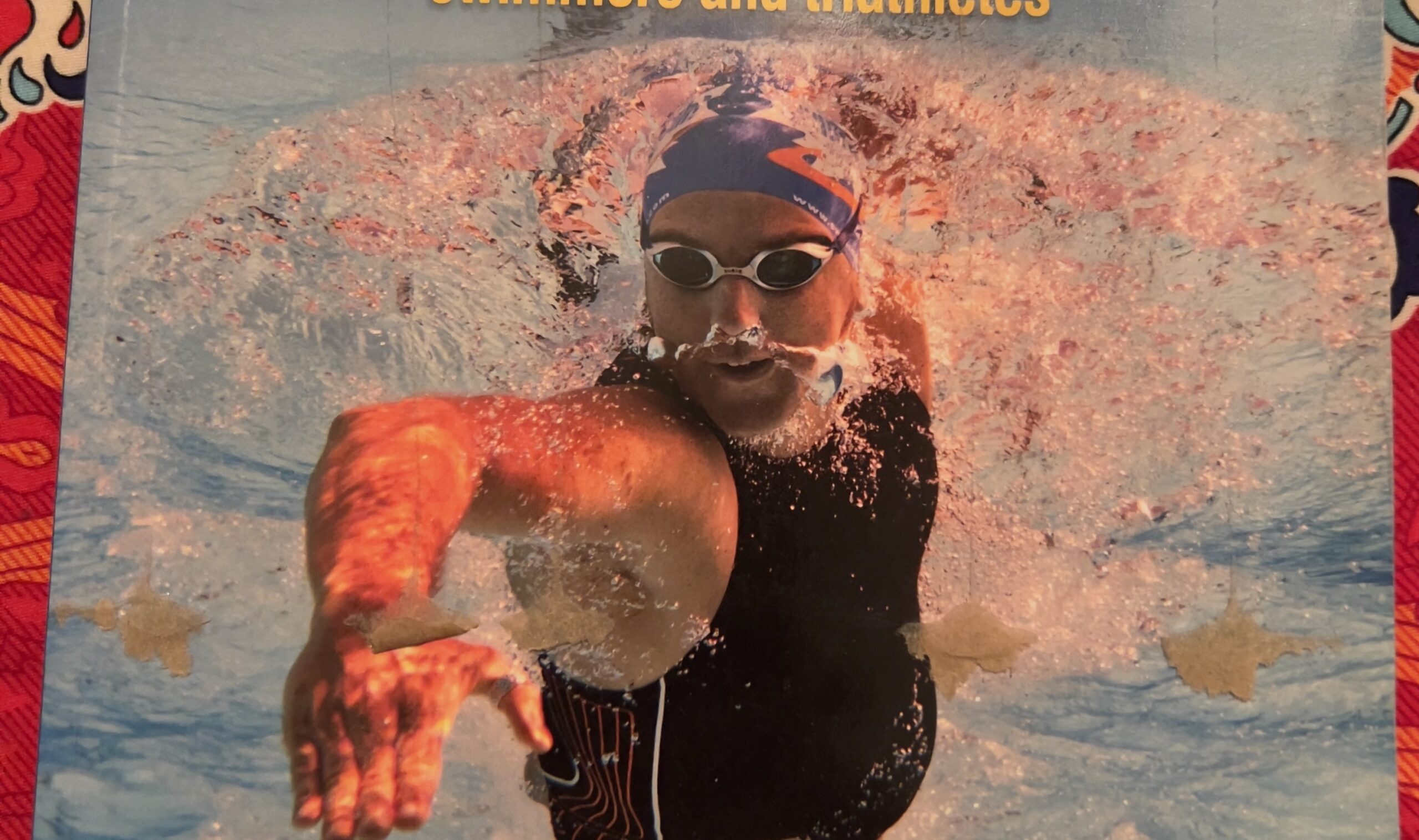
Please feel free to leave questions in the comment section or email me directly.  The photos at the beginning of the article are of some of the books I've read and/or use for reference.  The 'Science of Swimming' by James E Counsilman is considered the "bible" of competitive swimming.  

Posted by Cyril O in blog, 0 comments
Swimming 101

Swimming 101

Freestyle (Front Crawl)

I have a pretty long, smooth stroke.  It is not for everyone but I’m pretty relaxed and quite efficient when I swim.  I’ve read quite a number of books on the subject and watched videos of people with different philosophies on the correct way to do things. 

Like pretty much everything else in life, not everyone is the same or equal and not everything works for everyone. 

I often see triathletes trying to up their game on swimming.    A lot of times, swimming is the weakest third of their race.  I’m not a triathlete but I do know how to help someone not be exhausted after the swimming part of the triathlon.  That’s the kicker.  Trying to get through the swim part without using up all your energy and still not coming last. 

I watch friends and family trying to give pointers.  “Put your arm in this way.”  “Breathe like this.”  Etc, etc. 

It all comes from the core really.  If you are not rotating your body properly, you won’t be able to breathe properly.  If you are not rotating properly, you will over stress your shoulders and not have a proper stroke. 

This is all assuming that someone is comfortable with putting their face in the water.  

Equipment

First item to get is a decent pair of goggles.


Secondly, a pair of fins.Not the diving kind that are really long but those designed for lap swimming.  They are shorter.

Something like these:

You will need them for the main rotation drill.

Drill, Drill, Drill. 

Think of a tugboat vs a sailboat going through the water.  Tugboat is flat and pushes through the water.  That's you swimming flat.  Then there is a sailboat, narrow, cutting through the water.  That's you with your hips in a 45°. 

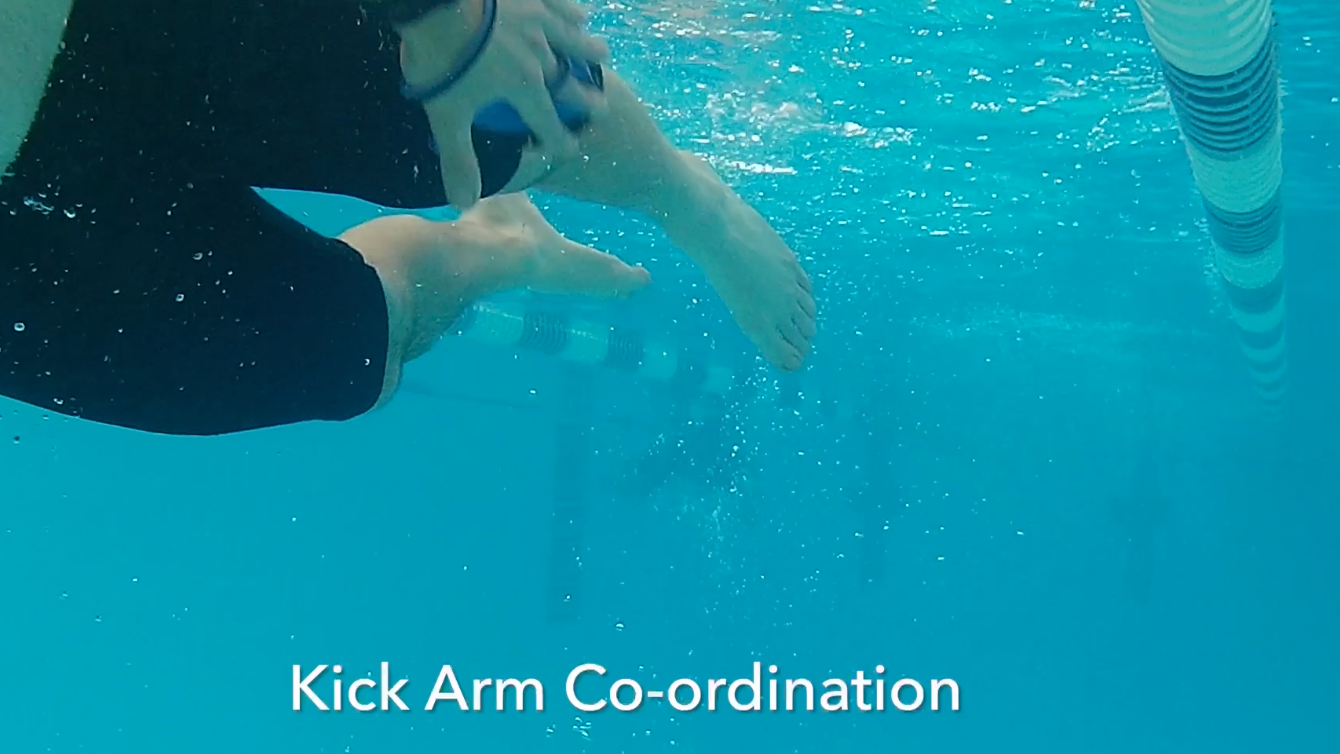
Most videos that I’ve seen suggest doing this drill completely on the side when practicing.  I disagree.  I think one should practice how they would do it in the stroke and also to help get the feel of the position.  You want to be at a 45° in the water and rock back and forth so each time you are sort of skating on that bone that you can feel on the front of your hip. 

Check out the images below first for the angle and then for the point you are ‘skating’ on. 

Put your fins and goggles on.  Push off from the side and cruise along on your left or right side to begin.  Take a good breath before you start or as you start to cruise then make sure your face is in the water. Make sure you are at a 45° and continue a long slow kick.  Go as long as you can on one side, take three strokes to switch sides.   Breath a couple of times as you are doing that.  Then stay there at the 45° angle again.  


As you are cruising and just kicking, you leave your lower arm in the water ahead of you a few inches in the water.  Your higher arm, hold along your hip that is higher or above the water. 

When you are ready to switch sides again, just start the stroke with the arm that is in front, one, two, three and you are on the other side.  Do a length and take a minute or two rest if you need it. 

More Drill

Swimming: I'm a big proponent of drilling.  Drilling parts of the whole stroke.  It would best if I could watch your stroke then coach you from there but...

In this video link, you can watch up to about 3:50 - 

Rotate hips

In that video he says to drill at 90°.  I disagree. As I said, I think you should drill the way you should swim.  Around 45°.  The more you do that the more you will get the feel for how your body should be in the water

Here is another video on this rotation drill.  Watch from the beginning but at 3 minutes you get a second drill.  I would suggest you do all these drills with fins.  I never drill any sort of kick without fins.  

If you are going to buy some fins, get a leg buoy and some sort of pull paddles at the same time.  The paddles/leg buoy work together and help lengthen your stroke.  

You are welcome to send me feedback and questions.  

Some great drills in this book by Blythe Lucero:


Posted by Cyril O in blog, 1 comment

2.5 km in 45 minutes

I have a ‘cross the lake swim’ I’m going to be doing in Kelowna, BC on July 20th.  2.2 kilometers (about 2300 yards).  One width of the lake.  I work out pretty regularly in the pool but wanted to see how long it took me to do 2500 meters(2.5 KM) at a steady pace. It took me about 45 minutes of continuous swimming.  Allowing for no line on the bottom of the lake to follow, hopefully, that will equal the time it would take me to do the crossing. That puts me a little faster than 2 miles an hour:)

Wish me luck.

Posted by Cyril O in blog, 0 comments
Swimming Stuff

Swimming Stuff

Me and My Swimming

I've been swimming ever since I can remember. I took lessons from the time I put my toe in the water. Swam competitively in high school, took a few years off and from about the age 28 or so have been on average about 6 months out of 12. In the last couple of years my schedule has allowed me to be more consistent and thus I have been doing more research to try to improve my stroke. For 30 years or so I would do 40 lengths or so and sometime squeeze it up to 60. Now 60 (a kilometer and a half - about a mile) is my minimum.
I've read a number of books over the last year or so and watched dozens of videos on YouTube and other places. I had a fairly good stroke, smooth and all but I wanted to reduce my number of strokes per length and generally make my freestyle more efficient. I'm of the philosophy that one has to duplicate something to understand it before one can have judgement. Actually, this sounds pretty logical but most don't really get it. So, what I did was take the Total Immersion technique and just robotically went about learning it. Once I had it and understood how my body moved through the water using this system, I was able to take what I needed and make it work for me and what I wanted to achieve with my swimming.

As I mentioned there are numerous videos on Total Immersion Swimming - I did also get a copy of the book on the subject by Terry Laughlin which has a lot more useful information and more depth that one would get in a video.

Another book that I have found very useful is called 'Shape Up!' by Blythe Lucero. Excellent information and great workouts. She has written several books but this was the one that I found the best for my level of swimming. It has a lot of great drills that are part of the workouts. I find that if I actually do them it improves my stroke. This, along with other aspects of learning some new techniques at my age was a bit tough at first as I often tend to think I already know things and that is a definite barrier to learning. I'm read some other books - some good some bad.

One of the thing that I have found most important in training is to really take gradients. Especially at my age. When I first increased the length of my workouts I did too much too quickly and overworked my shoulders. I had to take a break. I took it back and increase very gradually. Also, pretty much every book and blog recommends recovery time. This goes for any sport and for me 3-4 times a week is plenty and gives my shoulders a rest. I sometimes would love to do more and if I really feel the need, I go and do a few miles on the bicycle.

I have also searched out some different blogs, by no means, I'm sure, all of the good ones. Some just have some good workouts and some websites have lots of marvelous, useful stroke information as well as good workouts.

For me the book Total Immersion was quite useful. It got me thinking about my freestyle and although I had a pretty smooth stroke, with this I was able to lengthen it and adjust a few things that made my stroke a whole lot more efficient.

There are a couple of different philosophies regarding what the 'best' stroke is. I try to take what works for me. For example I learned the 'Total Immersion' technique so that I knew how it felt. I'm better at distance swimming and this worked for me. Even then, once I had learned the techniques for freestyle from this Total Immersion Swimming method I then took from that what worked best for me. I do find that I have a different style for sprinting as to what I use for distance. I am using about 25% fewer strokes and for 400 or 800 meters I am doing the same or better time.

Some good references:
- this is a marvelous site. Full of all kinds of information with interactive tests and an excellent forum: http://www.swimsmooth.com
The information from this site definitely helped my stroke: http://www.totalimmersion.net/. Tons of great videos here and on YouTube.

If you like to change up your workouts this blog has different swim workouts for different levels posted most days. For me this is great - keeps it interesting. If you email you can also get questions answered:
NTC: Nation Training Center - a blog kept by Sara McLarty

Everyone is different and we are all shapes and sizes. Some techniques will work better for one person than others. As I said though, if I learn a technique - really duplicate it and then understand how it works for me - then I can have some judgement. Once I have learned that technique fully I can then take what works best for me and apply.

The websites for Canada Master Swimming and USA Masters Swimming also have a lot of useful information including times so that one can compare how they are doing to other master swimmers.

Posted by Cyril O in blog, 0 comments