blog

Coach Swimming – One Thing At A Time

Coach Swimming – One Thing At A Time

Coaching Swimming

When I’m coaching swimming… I do this more casually than professionally.  The key in coaching or teaching is “one thing at a time”. 

One Thing At a Time

The key here is to figure out the biggest departure from the individuals ideal form.

We are all individuals.  All different. There are some basics of course.  And these basics are so, so important. 

I do basic drills every workout. 

I watch coaches and swim instructors.  Often trying to correct 2, 3, 4 or even 5 things at once. “You need to do this with your arm, while you breathe better and don’t forget to kick.”  Doesn’t work.

No one can learn properly that way. In any subject. 

Teach only one thing at a time!  This is really, really important. 

And everyone is different.  Not everything will work for everyone.


Two of the biggest faults I find are difficulty with breathing and not enough ‘turn’ or rotation. 

Breathing

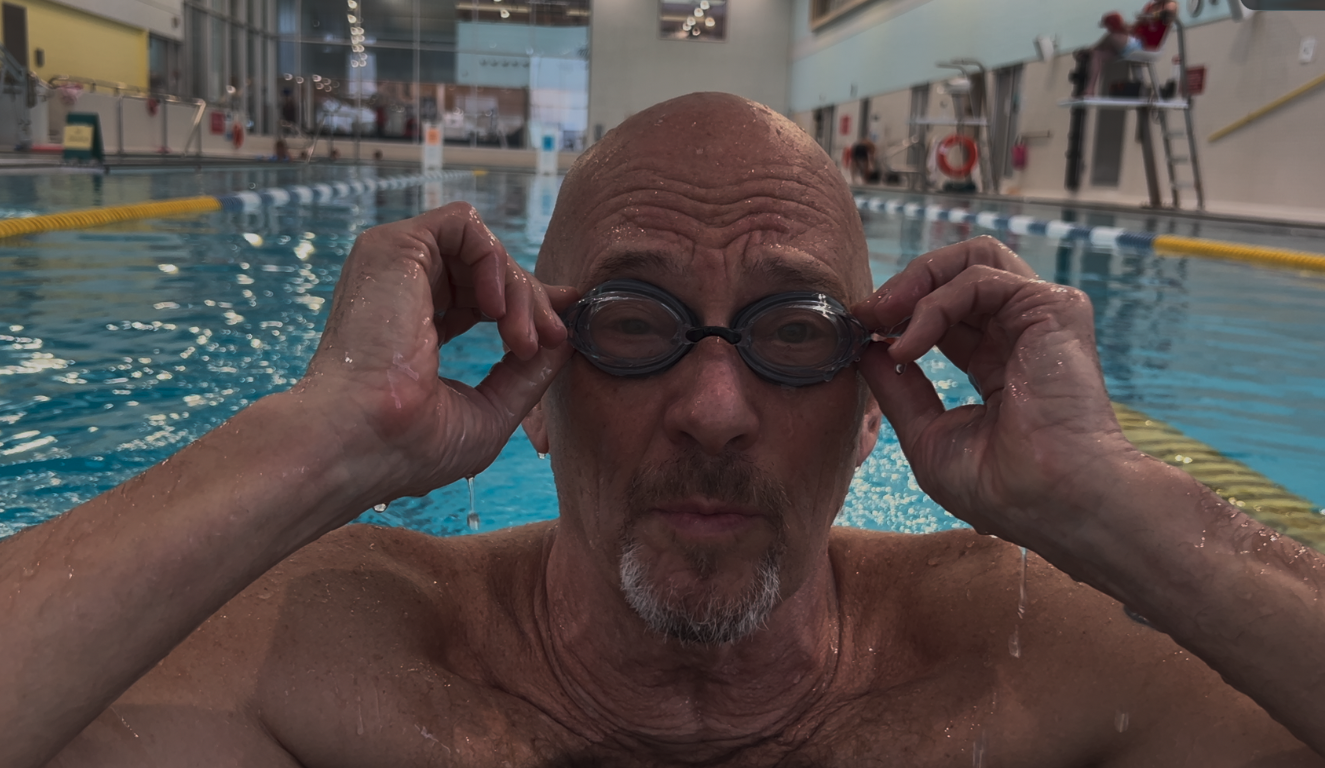
I often, with very sloppy or new swimmers, tell them they have to practice bobbing.  Most don’t want to do this because they feel that’s only for children.  Watching them swim, I see that they are lifting their head to breath. The reason for this can be from a variety of things.  One, being that they need to wear goggles.  That is usually a pretty simple fix.  A trickier thing is that the swimmer is trying to breathe out and in while their face/mouth is out of the water.  Takes too long.  That's why bobby is taught as a drill to children. If taught properly one learns to breathe out underwater and in while their face is out of the  water.

Need to get used to breathing in while out of the water and breathing out while under the water.  If they don’t have this drill conquered, they try to breath out and in at the same time while they are swimming.  As a result their face/head is out of the water too long or they tend to lift their head to get enough air.  Either way their stroke gets messed up.  If they lift their head, feet sink and they drag.  The bobbing drill helps to fix that.

Turn Baby Turn

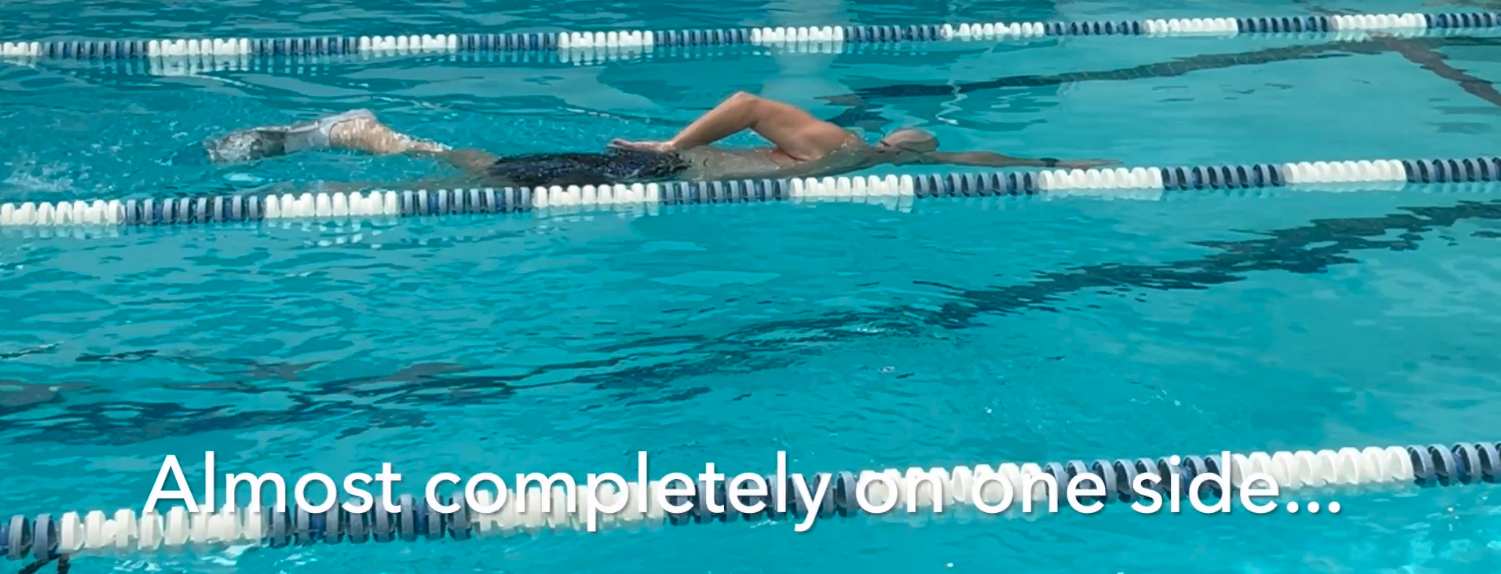
The biggest fault I see, though, with many and more advanced swimmers, is the lack of rotation.  That’s why I do my ‘skating’ drill every workout.

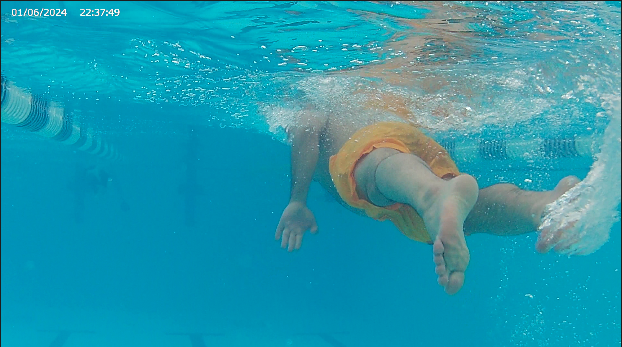
I kick, with fins, half a length, switch sides then, do the rest of the length on the other side.  "Skate" on the front bone on your hip. Usually it is about a 45°  angle.  Now, again, everyone is different.  So, the angle that is perfect for you may not be perfect for someone else. Find your sweet spot for your freestyle stroke.  Some say to exaggerate this exercise.  I disagree. I think one should drill the exact thing you want to be doing.  But that's just me.

What this does, swimming with a proper rotation, allows for a number of different benefits.  One, your reach will be longer.  In some cases, lots longer.  You will be doing fewer strokes per length.  The negative trade off for that will be fewer breaths if you are breathing the same pattern.  Adjust.  Also, as your hand is exiting the water, if you are rotating, you will find it is much easier to get that little extra push.  

Another benefit is that you are using more and varied muscles.  Using your latissimus dorsi as well as your arm muscles. They are stronger.  You will feel it.

Kick: Two Beat Kick

And it’s best when you are doing longer strokes like this that you do a two beat instead of a six beat kick.  The propulsion that you get from a six beat flutter kick is terribly overrated.  Even back in the 1960s - James E Counsilman's book The Science of Swimming - he tested this extensively.  Showed that kicking like crazy was not getting you there much faster.

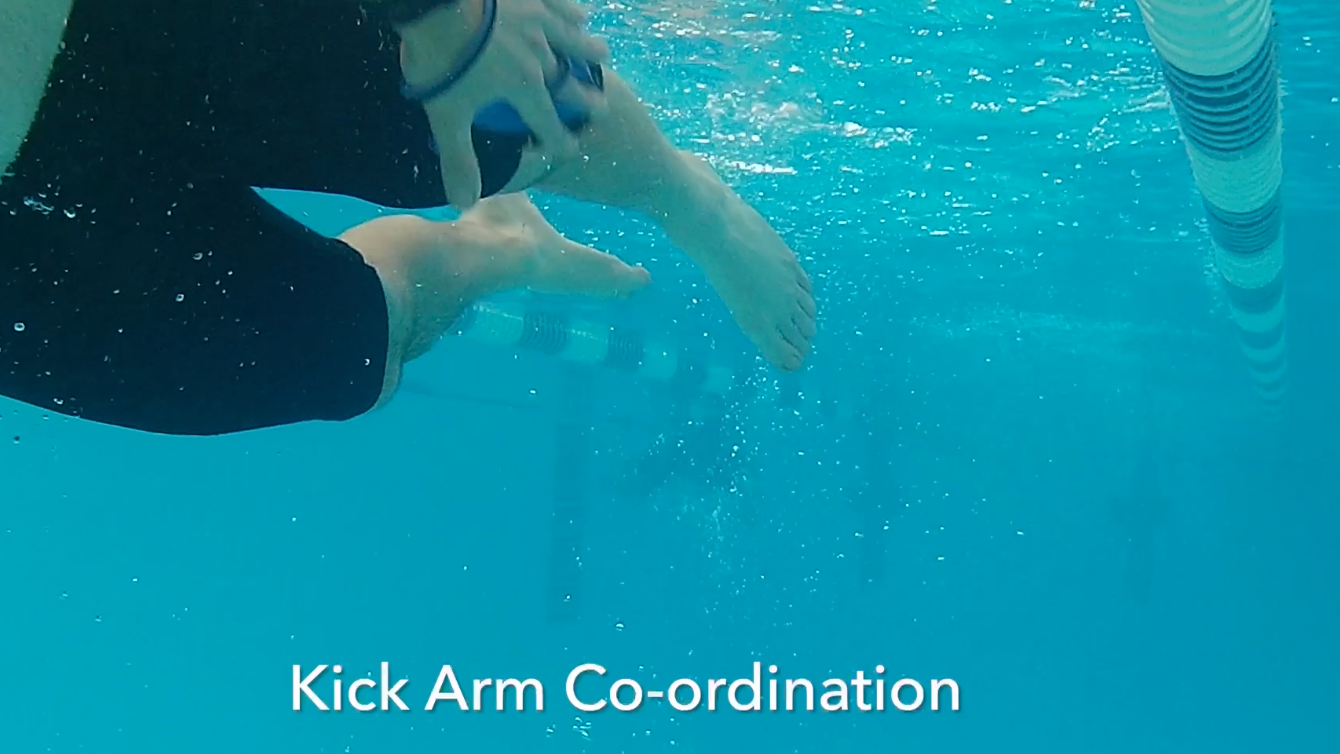
Personally, I use fins when I do kick drills.  I’ve learned to do a two beat kick and fins strengthen the muscles that I use.  I get a stronger kick this way without fluttering away uselessly.  The fins really work the necessary muscles.

Paddle and Buoy Drill

Using hand paddles and a buoy between your thighs as a drill is very helpful to get the feel of a proper stroke.   It is hard to just drag your hands and arms through the water and waste energy when you are wearing hand paddles.  And if you are doing a proper rotation you will really feel the muscle groups being worked: your lats particularly. 

Please feel free to leave questions in the comment section or email me directly.  The photos at the beginning of the article are of some of the books I've read and/or use for reference.  The 'Science of Swimming' by James E Counsilman is considered the "bible" of competitive swimming.  

Posted by Cyril O in blog, 0 comments
Urban Legends – Question Everything

Urban Legends – Question Everything

Urban Legends - Question what ‘Everybody Knows’!

I like to question some of the common ‘truths’ that are sort of ingrained in our culture/society.  I sometimes find truths that are not true.

Lemmings - Mass Suicide

You will still find people that believe that lemmings committed mass suicide.  Years ago psychiatrists and psychologists had a field day with this.  They felt this explained all sorts of human behaviour based on this scientific fact that ‘everybody knew’.    

If you are wondering how this came about… Disney’s documentary ‘White Wilderness’ in 1958 depicted this as something that actually happened.  But it was just some Disney movie maker’s dream.

I discovered this back in the 1990s but have heard this referenced as recently as a few years ago.

And another:

Chemical Imbalance In the Brain

For the decades that this idea has been about, I’ve thought that it is ‘bull kaka’.  I was never, ever, able to find any research paper that actually proved this to be the case: that a chemical imbalance in the brain caused things like depression.

And I searched.  I used to offer people huge amounts of money if they  could find any documentation proving its existence.  I never paid a cent.

So now, even though it has gotten to ‘urban legend’ status the whole idea of a chemical imbalance in the brain causing things like depression has been debunked. 

For a quick look, use ChatGPT and ask it this question:

“Where did the idea of chemical imbalance of the brain come from?”

(I won’t post the complete answer just this part.)

“4. 1990s: Marketing, Not Neuroscience

The phrase “chemical imbalance” became widespread during the SSRI era (e.g., Prozac).

Key point:

•The phrase was popularized by pharmaceutical marketing

•Not discovered by neuroscience

•Not validated by biomarkers

FDA testimony later confirmed:

There is no laboratory test that diagnoses depression by chemical imbalance

Even leading psychiatrists acknowledged:

‘The phrase was a metaphor, not a proven mechanism’.”

Please don’t attack the messenger. 

I’m more inclined to read book - and have read several on the subject - but seems to me that ChatGPT and other AI programs are able to spit out some truth.

🙂  You just have to ask the right questions.

Posted by Cyril O in blog, 0 comments
Shepherd’s Pie Recipe with Lamb

Shepherd’s Pie Recipe with Lamb

Shepherd's Pie Recipe with Lamb

As kids we’d get Shepherd’s Pie with beef.  Actually, it should be with lamb.  Shepherd: Sheppard's Pie with Lamb … get it? 

Shepherds take care of lambs, right!?  In actuality, Cottage Pie is what one would call the 'all beef' pie of the same nature.

So, my recipe contains both ground beef and ground lamb.  Some don’t fancy lamb.  (Some don't fancy pork.)

But this recipe still tastes like lamb but not a terribly strong a taste.

Please note, what I lack in culinary expertise, I make up in confidence and enthusiasm!

I’ll get on with it:

Ingredients For Shepherd's Pie Recipe With Lamb and Pork

1 Tablespoon of (I use Ghee-it handles heat better)  And I really use more than one tablespoon.  Some of the ingredients soak up the butter

1 Teaspoon Black pepper

1 pound ground lamb (or so)

1 pound of ground beef (or bison if you can get it)

1 large onion finely chopped

1 cup frozen peas

1 cup frozen corn

Thyme

Glass of red wine

2 Tablespoons of tomato paste

2 Tablespoons of Worcestershire sauce

2 Tablespoons of flour (or so)

1 Cup Chicken stock.  I use a beef stock as that’s what I have. A powdered bone broth.  You can see the photo in the image section.

Lots of mashed potatoes- you will need more than you think

1 Beaten Egg

Grated Asiage or some hard cheese

Salt to taste

And now…for the actual Shepherd’s Pie Recipe

Steam a large amount of potatoes while you are doing everything else.  I never peel the potatoes.  Some would find this offensive.  I like to get all the nourishment that I can.  And flavour.

  1. I chop a couple of large carrots finely and sauté for a while in Ghee.  I do these first because it takes a while to soften them.
  2. Remove carrots and sauté the onions.
  3. Remove the onions.
  4. Add the meat and cook till brown.  Some recipes call for removing the fat once cooked.  I never do.  There is way too much flavour there.  If things are too watery add a bit more flour later.  Season with Thyme and Pepper while cooking
  5. Add Peas, Corn and Carrots. Stir
  6. Add tomato paste, wine, and Worcestershire sauce
  7. Reduce a bit then add stock.
  8. You can add some salt anywhere along the line.
  9. Simmer until it is thick enough for your taste or you just can’t wait any longer because the smells are driving you crazy.
  10. Spoon the mixture into one or two glass dishes. 
  11. In there somewhere you have mashed the potatoes.  With lots of butter, milk or cream and salt.
  12. Spoon the mashed potatoes to cover the meat mixture.  Hopefully, you have enough potatoes to make a nice thick cover.
  13. Whisk an egg and baste the potato.
  14. Grate some hard cheese over the egg.
  15. Place in an oven for 20 minutes at 350

And now you are ready for dinner!

Remove from the oven, let sit for a few to let cool so that you don't burn your tongue!.

Don’t ignore the fact that you now have an open bottle of wine.

The Joy of Creating - Cooking

Cooking give me great pleasure.  Like I said earlier I’m not a culinary genius but I am pretty good at following directions!  And I truly love food. Because restaurants never compare to the flavours from cooking at home.

You will notice in this particular iteration of my Lamb Shepherd’s Pie, I kind of over filled the dish.  I should have had more potato which would have worked better with one large dish with one of the smaller ones to handle everything.

Please let me know if you do try the Shepherd’s Pie recipe!

Here is a link with a few more recipes with New Zealand Lamb

Posted by Cyril O in blog, 0 comments
Kayaking Queen Elizabeth Wildlands

Kayaking Queen Elizabeth Wildlands

Black River Kayaking - Queen Elizabeth II Wildlands

This kayak trip happened a couple of weeks ago.  We’ve been wanting to go kayaking in the Queen Elizabeth II Wildlands along the Black River for a number of years.  Never got around to it. I finally made sure I loaded the kayak racks into the car.  And made sure they made it up to the cottage.

Queen Elizabeth II Wildlands Provincial Park - Getting there!

Coming from Housey’s Rapids:  The road changes into Cooper's Falls Rd (or vice versa) at Black River Rd.  At that point turn onto Black River Road which takes you into Queen Elizabeth II Wildlands.  A few minutes from where you turn onto Black River Road, you will come to a fork in the road, or a turn off if you may.  A bridge to your right onto a road called Chisholm Trail (Route 6).  Don’t cross the bridge because you’ll be going the wrong way :)!  The rest of the road is pretty rough, consequently, really shouldn’t be called a road.  About half way to Victoria Falls, you will come to Rosebush Landing.  It’s easy to miss, so keep an eye out.  If you come to a wider section with a decent size, sandy parking are on the right, you have gone too far.  It is possible to put down there, if the water level is right.

Loading into the Black River in Queen Elizabeth Wildlands

At Rosebush Landing there is a winch and stairway/ladder designed to help get boats into the river.  There is enough of a bank at the bottom of the stairway to make is safe getting into the kayaks and into the water.  Thank you to the person or persons that installed this. We had a 12 foot and an 8 foot kayak, so we didn’t really need the which.  Though is was a lot of fun using it. 

As I mentioned there a couple of other spots that one can get in but at this point the Black River was several feet low making them a bit too difficult to access.

Below are three images of the area, each one drilled in a bit closer in to the launch site.

The Actual Kayak Ride Down the Black River

Our trip total was about 12 Kilometres.  At about the 9010 K mark, there are water falls. At a place called Big Eddy.  There is a 2-3 drop before the major falls which drop 10-15 feet or so.  Definitely a portage moment.  It was suggested that one climb down the left side which we did.  We parked the kayaks and did a little exploring on the little island in the middle of the falls. 

From there it was about 2 kilometres to Cooper’s Falls.  I tried to call my wife to come pick us up as we were close to the end.  Because the river was so far below the road level at this section, I got no reception.  Had to wait until we climbed out!

We'd done about 12km at this point and because it was getting late we exited the river just before Cooper's Falls.  Also, after Cooper’s Falls the river turns south and I'm pretty sure there are very few places convenient to exit. The river, from that point goes south then west then north and ends up near Washago or Severn Bridge.  No road alongside, as we had. 

I’m guessing it's at least another 20 plus Kilometres!

End of the Day

If you do this in the summer, bring bug spray.  We did this trip in the middle of September thus no bugs!   Earlier there would have been for sure.  Plenty of shade so not a big deal for the sun.  But even middle of September it was hot, so bring plenty of water.

Have fun.

More about Queen Elizabeth II Wildlands Here

My Photography Blog

Posted by Cyril O in blog, 0 comments
The Importance Of Living by Lin Yutang

The Importance Of Living by Lin Yutang

From “The Importance of Living” Chapter ‘On Playful Curiosity’

By Lin Yutang (written in 1937)

“It is for this reason that I hate censors and all agencies and forms of government that try to control our thought.  I cannot but believe that such a censor or such a ruler is wilfully or unintentionally insulting human intelligence.  If the liberty of though is the highest activity of the human mind, the the suppression of that liberty must be the most degrading to us as human beings.  Euripides defined the slave as a main who has lost this liberty of thought or opinion.  Every autocracy is a factory for turning out gorgeous Euripidean slaves. Don’t we have fine examples of them, East and West, in the twentieth century and at the very home of culture?  Ever autocratic government, no matter in what form, therefore, is intellectually retrograde. (retrograde:” Moving backward; having a backward motion or direction; retreating”)

We have seen it in the Middle Ages in general, and in the Spanish Inquisition in particular.  Short sighted politicians or clergymen may think that uniformity of beliefs and thought contributes toward peace and order, but historically the consequence is always depressing and degrading to the human character.  Such autocrats must have a great contempt for the people in general when they do not confine themselves to ordering a nation’s external conduct, but proceed also to regiment the people’s inner thoughts and beliefs.  They have a naive assurance that human minds will put up with this uniformity and that they will like or dislike a book or a concerto or a moving picture exactly as the official propagandist or chief of publicity bureau tells them to.  Every autocratic government has tried to confuse literature with propaganda, art with politics, anthropology with patriotism and religion with worship of the living leader. 

It simply can’t be done, and if the controllers of thought go too far in running against human nature itself, they are thereby sowing the seeds of their downfall.  As Mencius* put it, ‘if the ruler considers the people as blades of grass, then the people will consider there ruler asa  robber or enemy’. There is no greater robber in the world than he who robs us of our liberty of thought. Deprived of that, we might as well go down on all fours, the the whole biped experiment of walking on two legs a mistake, and revert to our earlier posture of at least some 30,000 years ago. 

In Mencian terms, therefore, the people will resent this robber as much as the latter despises the people, and exactly in the same proportion.  The more the robber takes away, the more the people hate him.  And as nothing is so precious and personal and intimate as our intellectual, moral or religious beliefs, no greater hatred can be aroused in us than by the man who deprives us of the right to believe what we believe.  But such short-sighted stupidity is natural in an autocrat, because I believe such autocrats are always intellectually retrograde. And the resilience of human character and unconquerable liberty of the human conscience always spring back and hit the autocrat with a vengeance.”

* Mencius was a Chinese Confucian philosopher who lived in the 4th century BCE. He was a prominent student of Confucius and is considered one of the most important Confucian philosophers after Confucius himself.

Posted by Cyril O in blog, 0 comments